
How To Use Sortition
to accurately determine what all of us would decide if we were all informed, fully participating, and able to deliberate with each other


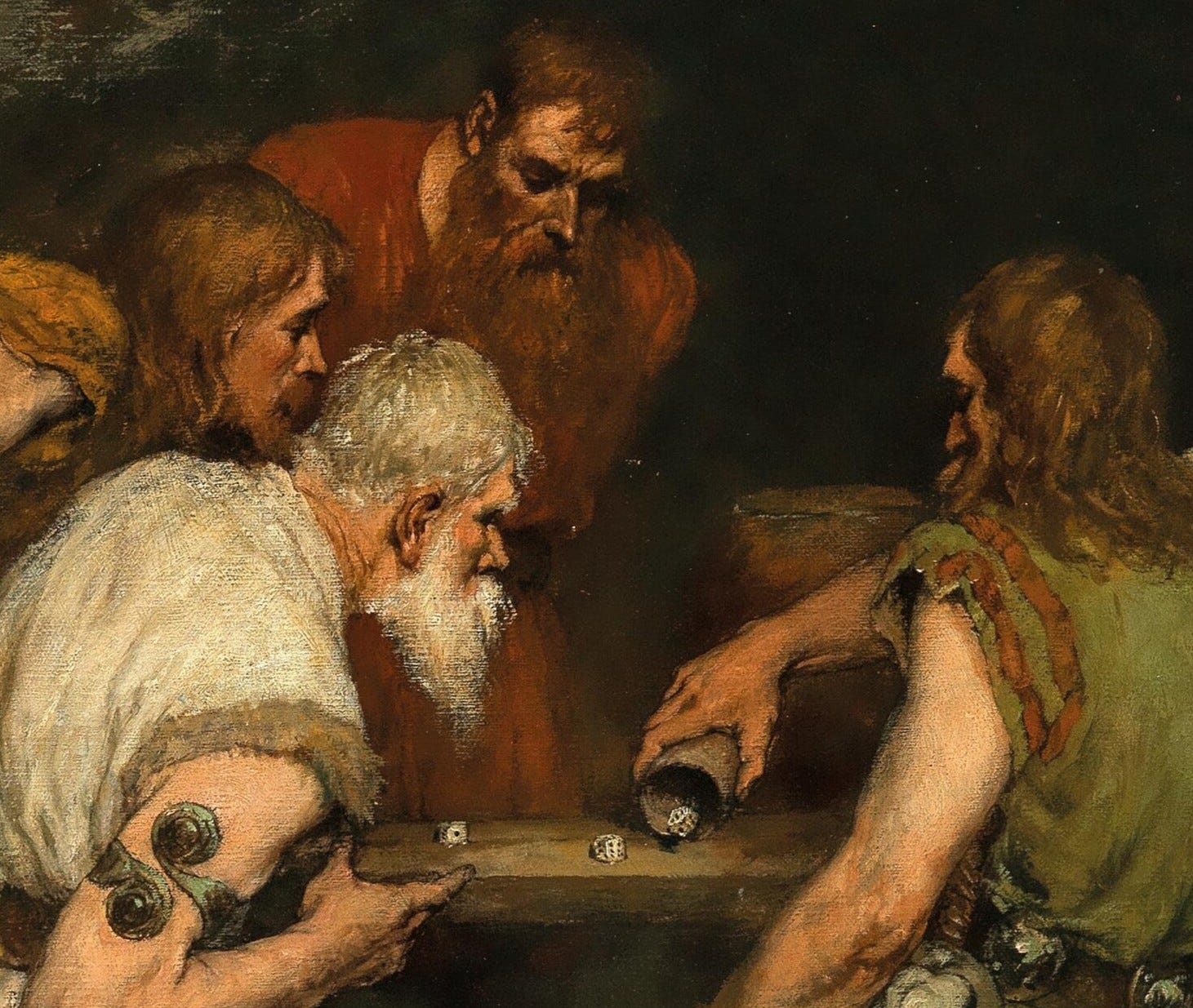
“A Game of Dice” by Ferdinand Leeke
Sortition is a tool. A powerful one that can promote equality, guard against corruption, represent enormous populations, and impartially distribute benefits and burdens throughout society.
But sortition is only a tool.
Sortition was used in Athens, a society that excluded women, held slaves, and frequently engaged in violent conquest of its neighbors.
Sortition was used to stabilize oligarchies in Italian city-states during the Middle Ages.
Sortition is used in modern-day juries within justice systems that are frequently harsher on marginalized people than they are on the privileged.
How we use the tool of sortition depends on what our purpose is.
In “Why Democracy” I argued that if we want to maximize our probability of survival and minimize the degree to which we are coerced, we want a government that will…
Unite all people who wish to use the same natural opportunities within the same government.
Give all people who must follow the rules an equal say in making them.
Govern with the greatest consensus possible.
If we take these characteristics seriously, we immediately encounter a major scale problem.
The atmosphere and oceans are natural opportunities that everyone on Earth depends on for survival, so… we need to attempt to give an equal say to every person on Earth?!?!
But not just a “say.”
We need to attempt to reach “the greatest consensus possible” with every person on Earth.
Consensus implies participants are informed, fully participating, and able to deliberate with each other.
So… the democracy we want isn’t possible?
No. We just need the right tool.
Not some high-tech, black box AI output that can’t be verified.
No.
A simple, ancient tool that has been refined into the most empirically validated method we have for dealing with scale: random sampling.
In other words, sortition.
Our purpose for using the tool of sortition is to accurately determine what all of us would decide if we were all informed, fully participating, and able to deliberate with each other.
Let’s explore how to use sortition, given that purpose.
Becoming “informed” doesn’t mean blindly listening to authority or getting brainwashed. Becoming informed is the process of exposing ourselves to new information with our minds open to the possibility that we are wrong. The point of becoming informed is to discover the limitations of our current knowledge and to understand the pros and cons of the approaches available to us so we can accurately apply our VALUES to the decision.
“Fully participating” means that people have an equal and robust opportunity to engage with a process and are motivated to do so. When we expect people to participate in sortition processes, we need to pay them well, cover their dependent care, and make accommodations for language barriers and disabilities.
To motivate people to fully participate, we must deal with the problem of rational ignorance.
When one person is a vote among millions, it is not rational for them to spend much time becoming informed, because it won’t make a difference. Rational ignorance is a free-rider problem that incentivizes people to take shortcuts and rely on others to tell them what to do.
We use sortition in order to put people in situations where becoming informed THEMSELVES is a good investment of their time. This means that we should not attempt to make sortition samples as large as possible, but only as large as NECESSARY to be representative. We need people to see that spending their time becoming informed WILL make a difference.
If we are “deliberating” with the goal of reaching “the greatest consensus possible” we need to design sortition processes to go beyond plurality or majority rule when they can. When we develop policy proposals, we need to make space for people to express their objections, develop alternative proposals to address those objections, and then use tools like Condorcet voting to find which of the proposal alternatives is preferred by the greatest number of people.
When we say “all of us” we mean EVERYONE who’s expected to follow the rules.
If we only use voluntary samples, we won’t get all types of people and our samples won’t be representative. For example, using only voluntary samples will unfairly decrease the influence of the busiest people and unfairly increase the influence of the most idle.
Although we should work to minimize coercion and only use mandatory sampling sparingly (for example to decide whether fully developed proposals are better or worse than the status quo, see below), it is not possible to eliminate all coercion from government.
It is less coercive to force relatively small, short-term samples into ensuring that we have just laws, than to have unjust laws and force everyone to follow them.
If we are going to “accurately determine” what all of us would decide, then we should apply the most empirically validated statistical techniques we have.
At a minimum, we need to understand that our samples are only temporary stand-ins. The longer that we have groups serve and the more functions that we have them perform, the more our samples will diverge from the population that we’re trying to approximate.
For example, any group that spends the time necessary to carefully craft a policy proposal is going to be biased in favor of their own work. Because of this bias, at least two fundamental types of sortition groups should be used…
Proposal Assemblies to develop proposals, and
Policy Juries to decide whether those proposals should be enacted.
Because the members of Proposal Assemblies will need to spend a long time learning and actively deliberating with each other in order to reach “the greatest consensus possible,” we probably need to make participation in these assemblies voluntary and limit their size to a number where all-to-all communication is practical. Probably no more than 150 people. Because voluntary sampling will introduce bias and because 150 people is not sufficient to represent large populations through simple random sampling alone, we should use stratified random sampling for these Proposal Assemblies. The multi-stage stratification process described by DemocracyNext in their “Assembling an Assembly Guide” makes good sense for this purpose.
However, stratification does introduce bias in the form of human judgment about which characteristics to stratify. “Should we stratify based on gender identity, sex assigned at birth, or both?” There’s not an objectively correct answer. For this reason, we should avoid stratification for the final Policy Juries that determine whether proposals are enacted. To reliably represent large populations using only simple random sampling, we need to increase the size of our samples to around 400 people. In order to maximize representativeness while minimizing coercion, Policy Juries should have mandatory service but should only last as long as it takes to cover the pro and con arguments for a single proposal and then privately vote to decide whether it will replace the status quo.
Because good ideas or critical insights might come from anywhere, both Proposal Assemblies and Policy Juries should probably be preceded by public input periods. These public input periods should provide a level playing field for anyone to submit and review relevant ideas, so that the best ones can rise to the attention of the Proposal Assemblies and Policy Juries. Systems like Pol.is would be well suited to fulfill this function.
Attempting to reach “the greatest consensus possible” should not be mistaken as an endorsement of supermajority thresholds. Supermajority requirements bias our government in favor of the status quo at the expense of democracy. Supermajority thresholds give the dead hand of the past a stranglehold on the present.
Instead, when it’s necessary to validate the accuracy of critical decisions, we can repeat sortition processes before policies are enacted. If two Policy Juries agree that a proposal should become law, that will increase our confidence in that decision. If Policy Juries disagree, we can repeat that Policy Jury until we are sufficiently confident about what “all of us” would decide.
Now, all of that seems like a ton of work.
I want to be clear that not every decision in a democracy needs to be made this way. But any government that claims its legitimacy is based on the “consent of the governed,” by definition, should ensure that any delegation of the people’s power is always based on the most accurate system available to determine what “the governed” would decide if we were all informed, fully participating, and able to deliberate with each other.
I think that sortition (representative random sampling) would be a much more accurate way to get the will of the people than the elite popularity contests we currently use. If you think most people would agree with me, then we come to a sobering realization: we don’t live in a democracy.
But, is democracy that important?
Well, if we don’t give everyone who must follow the rules an equal say in making them and earnestly attempt to find the greatest consensus possible, then the currently strongest voices may obscure even stronger coalitions hidden within the group. We want to find the strongest and most stable government because we want to maximize the number of people willing to help us and minimize the number of people who could be motivated to harm us.
The democracy we want is about maximizing our chances of survival and minimizing coercion.
It sure seems like that might be really important in the not-so-distant future.
The design recommended in this article is based on “multi-body sortition” as developed by Terry Bouricius
 | A guest post by
|
We don't yet, and may never, have a "one-size-fits-all" design for sortition/mini-publics/representative sampling/Citizens' Assemblies, but in my opinion this is a cogently and coherently-written argument for the basis of design for general use. Thanks, Ian. 🏆