
Why Democracy?
And how we are being manipulated into believing we already have it


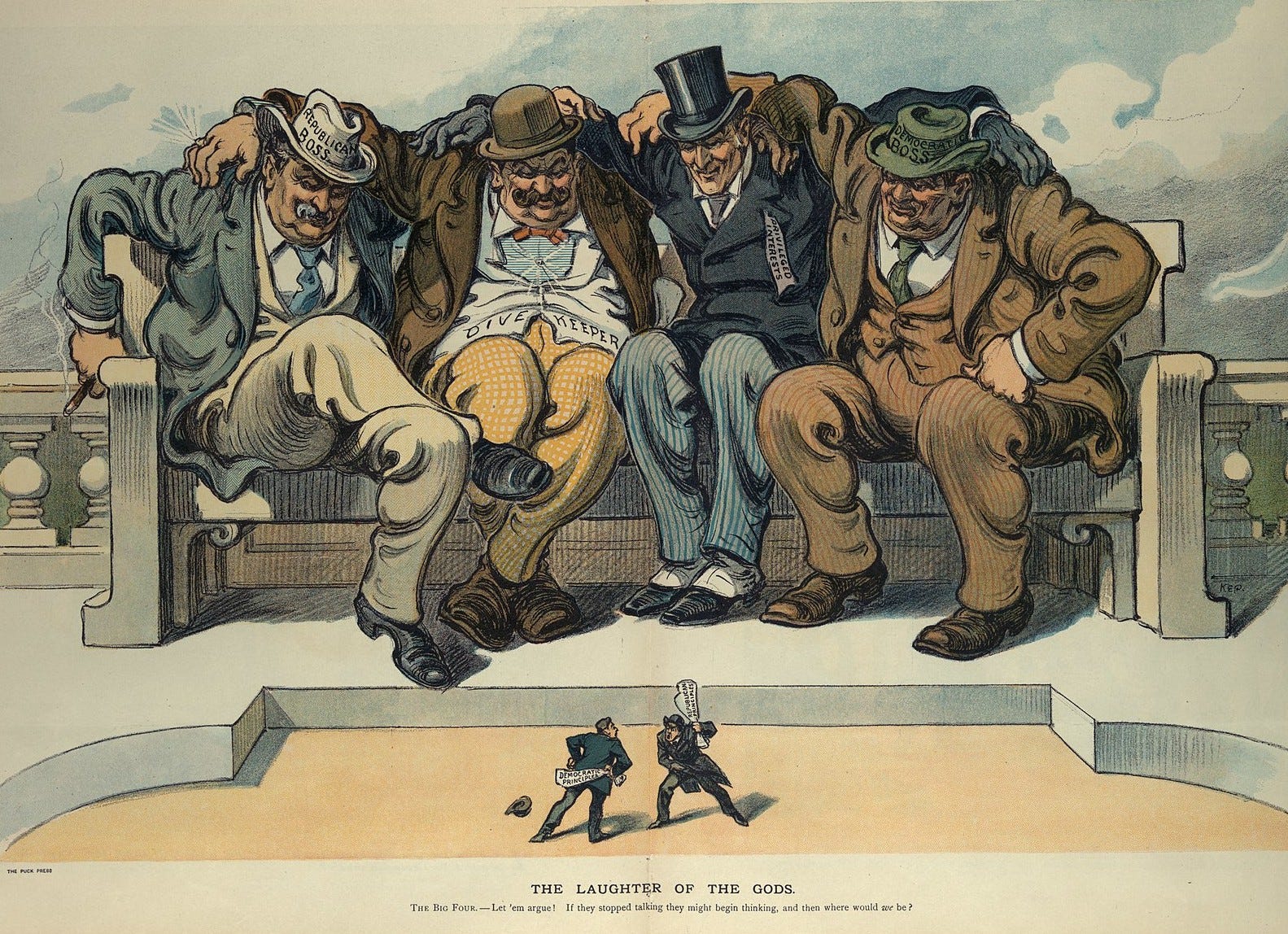
An illustration from Puck Magazine entitled “The Laughter of the Gods” depicting two small figures arguing over ‘democratic’ and ‘republican’ principles as four large figures look down on them in amusement: a Republican Boss, a Dive Keeper, Privileged Interests, and a Democratic Boss.
I previously wrote an essay entitled “Why Sortition” where I outlined my arguments for why I believe randomly selecting groups of decision makers is the appropriate way to scale democracy anytime a majority of us can’t reach informed agreement about what to do.
But I skipped a step.
I skipped “Why Democracy?”
But first!
“Why Government?”
Well, because there are many scenarios where what is best for the individual is harmful for the group (i.e. tragedies of the commons, free rider problems, etc.). These collective action problems are not simply products of our own society. They have always existed. There are many possible ways to deal with them, but essentially all the solutions could be fairly called ‘government.’
“Why not aim to replace the ‘government of persons’ with the ‘administration of things’ and let all people do what they want in a state of communist abundance?”
“From each according to his ability, to each according to his need” and all that.
Because there is no objective definition of ‘need.’ Because as long as people care about different things and have to cooperate on a finite world, we will need to decide how to allocate scarcity.
Alright, what about…
“Freedom and democracy are not compatible. Why make a government any larger than it has to be to secure markets, enforce contracts, and protect private property?”
Well, because most of the things upon which all human lives depend were not created by any human (i.e. land, water, air, natural materials, low-entropy energy from the sun, etc.). So any method of assigning permanent ownership of them is essentially arbitrary. In cases where all uses of these natural opportunities are not simultaneously compatible, we need to determine who can use what and how.
Now that I’ve attempted to respond to those less common perspectives, let me ask again: “Why democracy?”
The answer is survival and the psychology of fairness.
Because it takes competence and effort to stay alive, living people usually have a basic level of competence and a desire to continue surviving.
Do you want to survive?
Fantastic!
Human survival seems to have generally been predicated on cooperation throughout history.
Extending this concept further, all other things being equal, the more people we can get to cooperate with us, the more power we will have to continue surviving and pursuing meaning.
Because we can’t assume a universally-agreed-upon reason for surviving or ‘purpose’, we should attempt to maximize the number of people who are empowered to pursue their own purpose by governing with the greatest consensus possible.
To minimize destructive conflict and collective action problems, we should attempt to unite all people who wish to use the same natural opportunities within the same government.
And because most people will not voluntarily accept less influence over their lives than others have, all people who must follow the rules should be given an equal say in making them.
If we want to make this democracy adaptable across the greatest range of possible sci-fi futures, we should add that a ‘person’ should be defined as someone…
who can make itself understood by the group, and
who the group believes could change its own mind about its purpose and about whether to support or oppose the society that is considering its personhood.
Groups who are unwilling to include new people out of concern that it might shift consensus away from the current group’s preferences, risk being outcompeted or replaced by groups who ARE willing to be more inclusive and find greater consensus.
And this is why I believe most people, out of a desire to maximize their probability of survival while minimizing being coerced, would support what might be a solar-system-wide, inclusive, consensus-based democracy committed to the flourishing of as many people as possible.
Democracy is so intuitive to most people that, if you happen to be one of the few individuals who seriously insists on NOT dividing power equally, the most viable strategy to get what you want is probably manipulation.
More on that in a minute.
What sorts of people insist on not dividing power equally?
Well… the US founding fathers.
The founding fathers believed that they were members of a ‘natural aristocracy’ that should rule over the rest of us. They believed that ‘We The People’ should be governed by our ‘betters.’
They thought this arrangement was best for everyone. They seemed to unironically believe this was the case for women, non-whites, and people who didn’t own land.
With that perspective in mind, let’s consider why the founding fathers - people who repeatedly badmouthed democracy - designed a system of government where elections play such a central role.
Could it be that elections are not actually that democratic?
Let’s consider some empirical data.
I very much doubt that figure is any better for Congress.
Are these workers just consciously voting in their “betters” to make their decisions for them, or is there something else going on here?
Do YOU think it’s a good idea for the people who make our economic decisions to have economic interests so different from our own? Do you think our “betters” will keep our values at the forefront of their minds when the next recession or depression rolls around?
I don’t.
There’s no law that says our rulers have to be significantly wealthier than the rest of us, but that is definitely what elections seem to produce. Consistently. All over the world.
Elections, when we think critically about them, are a forced choice about who to delegate decisions to - and we, as individuals, have no control over what decisions we are delegating or which middlemen are available for us to delegate to. And wealthy, well-connected people who don’t have to work or care-give just have a much better chance of being seen as ‘viable’ in the critical, early ‘invisible primaries’ of the donor class.
Looking back to the founding fathers, the reasons they chose to use elections should now be getting clearer.
“But maybe elected politicians do really make better decisions than average people!”
Nope.
In the domains that are exclusive to politicians, there are no objectively ‘right’ answers.
There are no objectively ‘best’ decisions.
Anyone can hire experts to help them make good TECHNICAL decisions, but for politicians it’s all about values.
The job of a politician is to balance competing priorities and decide what the goals are.
No one can be an expert on another person’s values.
No one can tell you what your priorities are.
Attempting to make someone else’s value decisions for them, is attempting to manipulate them.
And that’s pretty much what I think has been going on. I think we have been manipulated into believing that politicians…
are necessary to scale our democracy and
are better at making our value decisions for us than we are for ourselves.
Absolutely absurd.
This deceit is accomplished by convincing us that ‘democracy’ and ‘elections’ are the same thing.
Now, I don’t necessarily think that sortition should replace all elections immediately. If regular people are good with the way the system is operating, then it doesn’t need to change. If we can design a system to keep our representatives sufficiently accountable, then that is just fine.
I just want the people who have to follow the rules to get the opportunity to rewrite them when the system is operating poorly.
And since it’s probably not possible to meaningfully include every single person in the writing of every single policy that will affect them, the best we can do is approximate the consensus that all of us might reach using representative random samples.
And if you believe that your perspective is too unique to be represented by statistically valid, random samples of your peers, then you must know that you weren’t going to decide those issues all by yourself through direct democracy anyways.
The critical thing, in my opinion, is that we give representative random samples of the people the power to update the rules for our rulers - areas where elected politicians have built-in conflicts of interest, like redistricting, campaign finance, and constitutional reform.
If you think that’s a good idea, consider joining us at DemocracyWithoutElections.org
 | A guest post by
|