



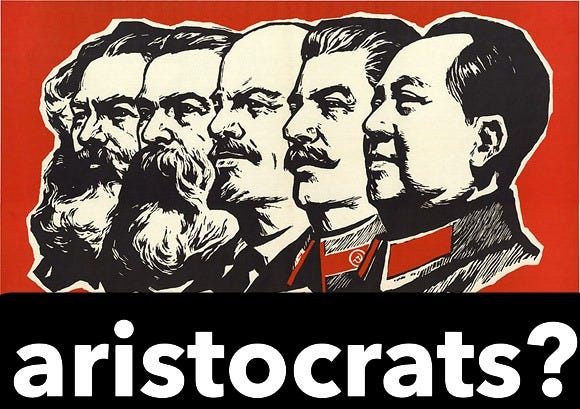
To my comrades engaged in the struggle for a more just world, let me attempt to convince you that underneath the existential problems of capitalism is a deeper problem. A problem that has ironically been shared by all the electoral “democracies” of the West as well as all the major communist and socialist governments that have existed.
The fundamental problem isn’t capitalism, it’s aristocracy: the idea that distinguished individuals - those with supposedly greater knowledge, moral standing, legitimacy, etc. - should make the decisions on behalf of the rest of us.
Aristocracy is the underlying philosophy for both elections and vanguard parties.
Now, you might be saying, “elections aren’t intended to just let distinguished people make the decisions, we pick politicians based on their ability to represent the will of the people!”
Or you might be saying, “Lenin, Mao, Castro, etc. weren’t just doing whatever they wanted, they were acting on behalf of the people!”
Here’s the thing: pretty much all aristocracies say they’re “doing the will of the people.” Kings and dictators say they’re doing the will of the people.
Don’t watch the mouth, watch the hands.
The key distinction between a democracy and an aristocracy is who gets the final say: common people or distinguished people?
Those are the original definitions. It’s all right there in the etymology of the words themselves.
Let me back up.
I spend a lot of time talking to people about sortition: randomly selecting groups of regular people to make government decisions.
It sounds crazy at first, but imagine we were scientists tasked with answering the following question: “what would the people decide on x issue if they could all fully participate, become informed, and deliberate towards consensus together?” There is no question that we would use representative random samples to find out. Representative random sampling is the most empirically validated, accurate method we have to represent large populations. So shouldn’t that make sortition the default method to operate a government of, by, and for the people?
Sortition would drastically increase the political power of working people - since they make up the majority of society - so it was a shock to me to discover that there is a significant group of communists and socialists who react poorly to the idea.
Some of them say that elections will work just fine under socialism: it’s capitalism that causes elections to elevate the distinguished.
Some say it’s pointless trying to change the government until you change the economic system.
Some say that common people cannot be trusted at this time because they are just too incompetent, brainwashed, racist, transphobic, etc. and therefore we need a vanguard party to pave the way.
Hear me out as I attempt to address your objections.
We have a world to win, and I believe sortition is how we win it. Let’s find a path through the conjuncture together.
Why Elections Will Never Empower Common People
Elections consistently elevate the privileged because in groups where everyone does not know everyone else, it requires privilege - of one type or another - to be known and preferred by enough people to win an election. The fundamental problem with elections is that the experiential knowledge and policy preferences of people in privileged positions in society don’t accurately reflect those of the population as a whole.
The US founding fathers famously bad-mouthed democracy and did not consider elections - which they incorporated heavily into their system of government - to be democratic.
The founders borrowed the idea of elections from the parliaments of Europe, where they had been used for centuries beforehand to facilitate negotiations between the monarch and the most influential merchants and landlords.
Thomas Jefferson - often considered one of the most “democratic” US founding fathers - explicitly stated that his goal was to create a “natural aristocracy.” His “Democratic-Republican Party” was actually just known as the “Republican Party” during his lifetime. The founders claimed that it was in the best interest of everyone - including women, slaves, and the poor - for the natural aristocrats (people like the founders) to be in charge.
Over time, as politicians found it useful to invoke the idea of “democracy” to win the votes of recently enfranchised common people, elections came to be misunderstood as democratic. But prior to the 1800s, elections were explicitly understood to be aristocratic. Aristotle, Montesquieu, and Rousseau all have quotes where they indicate that if you want an aristocracy, you should use elections and if you want a democracy, you should use sortition.
In a bitter irony, electoral aristocracy was spread around the world as “democracy,” while sortition was forgotten for nearly 200 years. It wasn’t until 1956 that sortition was seriously brought back into public discourse by the black socialist and historian CLR James in his essay ‘Every Cook Can Govern.’
James’s essay was in response to Lenin’s statement that, “We are not utopians. We know that an unskilled labourer or a cook cannot immediately get on with the job of state administration.” As a Trinidadian descendent of slaves familiar with the paternalistic excuses for colonialism, James rejected the idea that empowerment should only come after being deemed worthy. James believed empowerment should come first and that all people expected to follow the rules should have an equal say in making them. James’s former wife noted that he chose the title “Every Cook Can Govern” with intentional awareness that women did most of the cooking. James recognized that sortition could empower all people to rule in turns within a context where they could realize their capacity to rule wisely.
Subsequent socialist thinkers played key roles developing theoretical approaches to sortition including John Burnheim in ‘Is Democracy Possible?’ (1985), and Cockshott and Cottrell in ‘Towards a New Socialism’ (1993).
The only decision elections permit common people to make is which distinguished people - in other words, aristocrats - will make decisions for them. Elections appear to be based on political equality because we all get a formally equal say about which elite campaign finalist will make decisions on our behalf, but - critically - we don’t get an equal opportunity to actually make political decisions ourselves. All other things being equal, people with greater privilege have a greater chance of winning elections, so the range of policies available for us to pick from is limited to the preferences of the most privileged members of society.
Wherever and whenever they have been used, elections have given power to the privileged, not the common people. The rarity of exceptions to this tendency proves the rule. This effect can be observed all around the world. It can be observed in US presidential elections and high school presidential elections. It was the case prior to capitalism and it has been the case since.
This is why quasi-socialist programs in electoral countries - such as social security, the NHS, etc. - all tend to erode and enshittify over time. Elections empower the privileged to make the decisions. Privileged people generally don’t need welfare programs and would rather spend the money elsewhere. Thus the hard won social programs put in place to appease mass movements are gradually rolled back by the privileged politicians who benefit the least from them.
Let’s take this analysis one step further. The reason the injustices of capitalism have not been ended by elections is because elections disproportionately elevate those who benefit the MOST from capitalism to make all the decisions.
After capitalism ends - as all things eventually must - if elections remain, they will sow the seeds of the next ruling class. Electoral delegate assemblies and workers’ councils would be full of the articulate, confident, and socially dominant.
Why We Must Change the Government to Change the Economic System
Marx said that, “changes in the economic foundation (i.e. capitalism) lead sooner or later to the transformation of the whole immense superstructure (i.e. the government).” Statements like this have been used to argue that in order to address societal injustice, we should focus on economic organizing rather than changing the government (i.e. attempting to codify sortition).
The interrelation between economic systems and governments is complex and not unidirectional but, eventually, the government must change before the economic system will, because property rights are managed and codified by governments (the institutions that govern people, territory, resources, etc.).
If the locally dominant governing institutions don’t acknowledge capital asset claims (i.e. to land, corporations, stocks, patents, copyright, etc.), those claims fall apart. Without the coercive powers of governments, anyone claiming capital assets would have no one to defend those assets except for themselves. And without the ability to recruit third parties to defend capital assets, it wouldn’t really be capitalism.
The power to govern human societies seems to come from: 1. the number of people that can be induced to cooperate or comply, 2. the technology those people can deploy, and 3. how those resources are put together strategically.
Sometimes there is a mismatch between the actual power to govern and what is written down, but changing what is written down matters because large governing institutions need codification to coordinate all the activity necessary to maintain their power.
In 1086 William the Conqueror codified feudalism across the United Kingdom with the Domesday Book and the Oath of Sarum.
Capitalism was codified piece by piece, in Parliament and the courts, during the Enclosure Movement.
During the Enclosure Movement, landlords in the United Kingdom enclosed what had previously been common lands in order to raise wool and other commodities to sell on international markets. The peasants fought back and the landlords - despite all their economic power - had to codify the new property relations through the government in order to benefit from the coercive powers of the state.
Changing the government - specifically changing the codified rules about property rights and who gets the final say - is a historical necessity for changing the economic systems of large societies.
Why Aristocracy Produces Scarcity and Starvation under both Capitalism AND Communism
Another consequence of the Enclosure Movement - in addition to the creation of capitalism - was the Irish Great Famine.
Between 1845 and 1852 over 1 million Irish people starved to death after a disease affecting potato plants destroyed one of Ireland’s most important food staples. The reason that so many Irish people died is because the Enclosure Movement had already pushed them to the precipice of starvation. By the time the potato blight hit, Irish commoners were already scraping by on the absolute worst farmland because they had all been kicked off their ancestral lands a few generations before.
During the Famine, Ireland exported more than enough food for everyone. And although some Irish people eventually benefitted from the international trade the Enclosure Movement helped to establish, that was little consolation to those who had to watch their children starve eating mud. The only beneficiaries at the time were the capitalist landlords. In other words, the political ruling class. In other words, the aristocrats.
This has striking parallels to the Great Famine of China.
Between 1959 and 1961 around 40 million Chinese people starved to death under the communist leadership of Mao Zedong in one of the single deadliest man-made catastrophes in history (for comparison about 11 million people died in the Holocaust).
One of the primary causes of this famine was the crop quotas local officials were required to send to the central government to be sold on the international markets in exchange for weapons and industrial supplies.
During the Great Famine, China exported more than enough food for everyone. And although some Chinese people eventually benefitted from the industrialization that the Great Leap Forward contributed to, that was - again - little consolation to those who had to watch their children starve eating mud. The only beneficiaries at the time were the leaders of the Chinese Communist Party. In other words, the political ruling class. In other words, the aristocrats.
Aristocracy is a governing philosophy that enables fallible individual humans to use the government (the ‘means of coordination’ if you like) to direct flows of vital resources away from the rest of us in pursuit of their own preferences. This happens under both capitalism and communism.
Why Aristocracy Worsens Public Decision-making, Regardless of the Economic System
Invariably, those who claim to believe that the distinguished people should make all the decisions count themselves among the distinguished.
Everyone’s always an idiot except for them, yet they lack the self awareness to recognize they aren’t the only ones who take this mutually exclusive position.
I don’t know who still needs to hear this, but elites don’t have our best interests at heart.
Just like everyone else, elites have self-interest. Additionally, it is estimated that people in high profile positions are four times more likely to be psychopathic than people in the general population.
And it does not seem like the class character of organizations can provide immunity to predatory individuals: take Cesar Chavez as a recent, high-profile example.
We can’t expect people “better” than us to remain ALIGNED with us. The tendencies for people to self-deal and to dehumanize those who are seen as inferior to them are too predictable and too strong.
Those tendencies don’t just exist under capitalism: take, for example, the 2 million victims of the Cambodian genocide led by the communist aristocrat Pol Pot.
Aristocrats are dangerous and we don’t need them.
To be clear, this is not an argument against expertise. We DO need experts, but aristocrats - including politicians and revolutionary leaders - aren’t necessarily experts in anything other than maintaining power.
Unlike with aristocrats, we can hear what experts have to say without needing to GIVE them the final say.
Experts can explain why they should be trusted over those who disagree with them, but ultimately, the people in power pick which experts to trust. It can’t be experts all the way down.
So, yes, who is in power does matter.
But, ironically, the logic of aristocracy - rule by the distinguished or the “best” - interferes with obtaining sound expertise. Aristocrats can’t meaningfully change their mind, because their right to make the final decisions is based on them already being correct on all the central issues, and this is the case for both elected politicians and the leaders of vanguard parties.
This systemic arrogance kills people.
Aristocratic arrogance contributed to famines in multiple communist countries (including China) after ideologically blinded communist aristocrats adopted the agricultural ideas of Trofim Lysenko - a pseudoscientist who rejected Mendelian genetics and contended that plants of the same “class” never compete with one another.
And aristocratic arrogance is contributing to existential climate change because capitalist electoral “democracies” keep insisting that our global response should center on profitable, market-based strategies. According to a 2025 report by the Institute and Faculty of Actuaries (the professional organization of UK insurance adjusters), the consequences of having our governments controlled by aristocrats - many of whom compete for the right to rule by vying for the support of those who benefit most from climate change - might include the death of 4 billion people, nearly half of us alive today. That is one hundred times the death toll of China’s Great Famine.
Why We Must Demand Sortition
A real democracy - a government truly of, by, and for the common people - would never have tolerated an economic system that works for so few of us for so long.
The reason the injustices of capitalism persist is because you and I have never seen a real democracy.
We’ve seen better and worse aristocracies in disguise.
Perhaps at one time it might have been reasonable to believe that there were elites out there who knew everything and could speak for all of us.
But we know better now.
No one knows everything.
The only group that cares about the wellbeing of all of us, is all of us.
But no human under the capitalist global economic system - or probably any possible global economic system - has the time and attention to deliberate towards consensus with every other person on every single issue that affects them. So, unless we are willing to go back to living in small tribes - and make ourselves vulnerable to any groups willing to build larger civilizations - we have to use a scaling mechanism. And representative random sampling - sortition - is the most accurate method we have devised for approximating those conditions.
The next time a crisis or a mass movement gives us, the common people, an opportunity to change the system, we should demand to be put in charge for once.
Aristocracy is a dead end, whether we are talking about elections or vanguard parties.
Sortition is our path forward.
If you would like to help us move forward along that path, we would be honored to have your help at sortitionusa.org/members
Ooh. Didn't know the history of "any cook can govern" being a response to Lenin.
A fantastic post by Sortition USA’s Ian Troesoyer… elections are our Achilles Heel, giving us the same blinkered “distinguished people” and reproducing the same problems across history and across societies. Sortition is the answer.