
How We Win
It is time to let the people rule


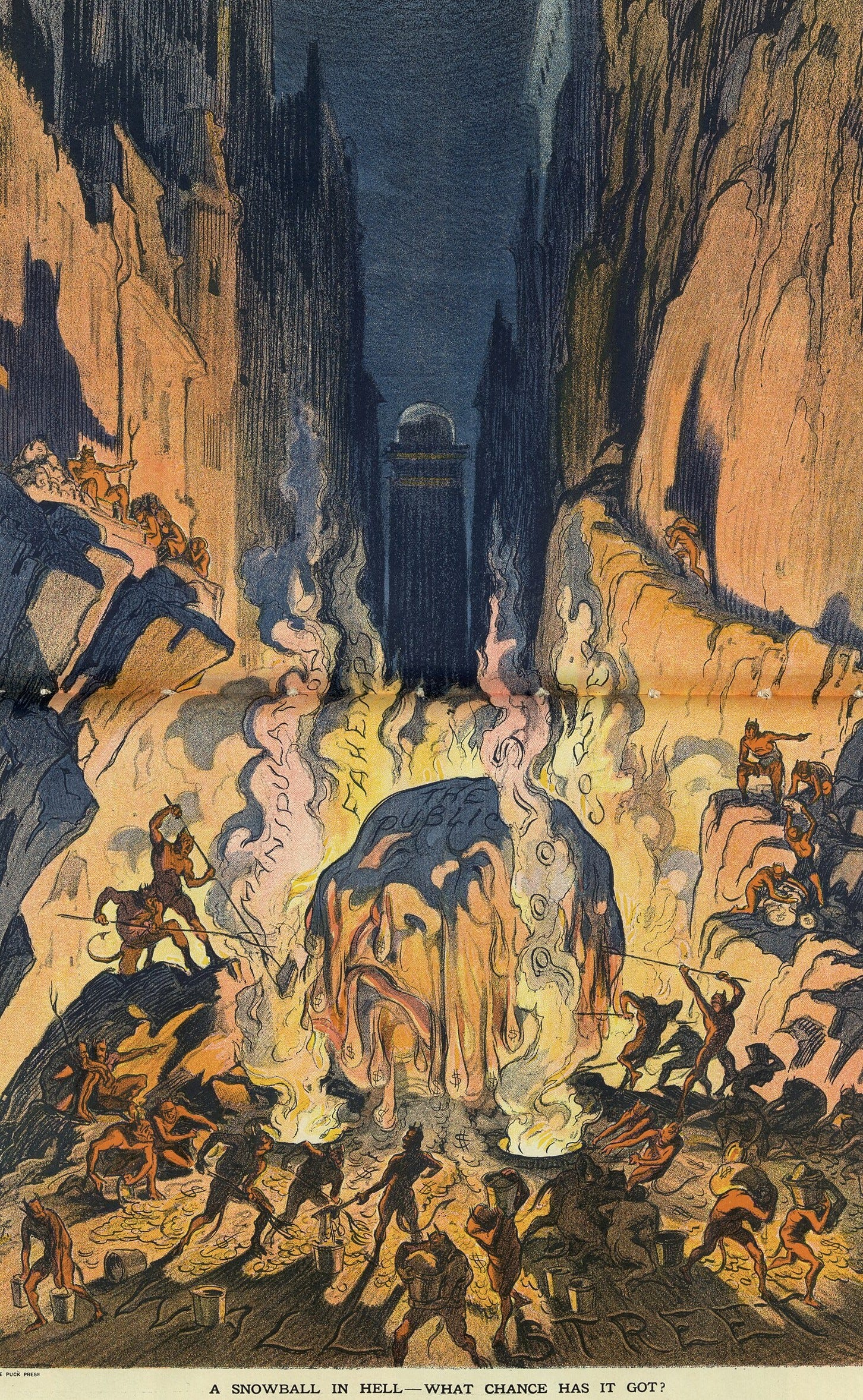
An illustration from Puck Magazine entitled “A Snowball in Hell - What Chance Has It Got?” depicting a large face-shaped snowball labeled “The Public,” dripping money as it melts, while devils carry off the cash and coins to Wall Street.
The goal of “winning” for me is maximizing the chances of survival and minimizing coercion for the people I love. In ‘Why Democracy’ I argued that in order to maximize the number of people who get that outcome (and thereby maximize the chances that I get that outcome), we should…
Attempt to unite all people who wish to use the same natural opportunities within the same government.
Give all people who must follow the rules an equal say in making them.
Govern with the greatest consensus possible.
Use the most accurate system available to determine what the people would decide if we were all informed, fully participating, and able to deliberate with each other.
The most accurate system I am aware of for approximating large populations is representative random sampling. Therefore, I think “winning” looks like a global, inclusive, consensus-seeking, sortition-based democracy - a geodemarchy.
I don’t think we’re going to get there without a plan.
This is mine.
Please think it over, critique it, and then get back to me about how we can make it all happen.
I don’t want to be right as much as I want to be working on the right solution, ideally with as many other people as possible.
My approach is to work through existing governments to get constitutions under the exclusive control of the people via sortition, focusing our efforts where individuals - not money or power - have the most leverage, and then to build a global sortition federation from there.
If that sounds good to you, you can skip to “The US Strategy” halfway through this essay. If you’re unconvinced or curious, read on.
Why work within existing governments?
I sympathize with people who think that electoral politics is a dead-end. After all, why do you think I support sortition?! However, I believe sortition is a fundamentally different type of reform which gives it a unique chance to overcome the challenges of electoral politics.
To begin convincing those people, starting with nothing but our shared belief that the governed should rule themselves, we need only ask, “what is the most accurate way to determine what the governed want?”
It’s not even a matter of opinion: representative random samples are the most accurate, empirically validated method we have to approximate populations.
Yes, it will be difficult. Yes, we have a long way to go. But people are waking up to the reality that they don’t live in democracies. We just need to point out why and then mobilize them to help us finish the fight.
Why the focus on constitutions?
The only place “the consent of the governed” or “democracy” really counts is the constitution.
At the level of constitutions, anything is possible.
At every subservient level of the law, one must first deal with whether an idea is constitutional.
Until constitutions EXCLUSIVELY and ACCURATELY reflect the consensus of the governed, we don’t have democracy.
We must not leave constitutions up to something as chaotic or corrupt, for example, as 9 lifelong partisan political appointees arguing over the interpretation of a centuries-old piece of paper.
Why expect sortition to give us a global democracy when electoralism has not?
I think most people want effective, fair global governance of our oceans, atmosphere, and earth. The trouble is that elections assign political legitimacy based on competitive power struggles, not on accurately reflecting the consensus of the governed, and this creates two major barriers to global democracy.
First, because any advantage can help in the competition for leadership, groups that can disproportionately benefit from environmental externalities hold a disproportionate amount of political power in electoral nations. This makes those nations less likely to fairly or effectively govern the use of the environment.
Second, in electoral nations, policy is inherently unstable. Rulers know that the government might swing significantly out of their favor unless their coalition remains in control, so they are incentivized against voluntarily transferring power, including from national to global scales.
Without another world war or some other serious global crisis, which we might not survive, I don’t think nations as they are will give us a global government, let alone one we would want. And while violence or catastrophe might force the creation of a global government, if that’s how it comes about, it probably won’t be a democracy (for example, consider the UN Security Council). Military secrecy and bitterness aren’t super conducive to the transparency and trust required for people to cooperatively rule themselves.
First, I think we will need a few nations to start basing their political legitimacy on democratic accuracy by embracing sortition. These nations can then put out a good-faith proposal for a global democracy that the rest of us can join.
And here we reach a fork in the road.
It is up to each of us to try to reach that first critical milestone: a nation whose constitution exclusively and regularly uses the best sortition processes available to accurately approximate the consensus of the governed.
The US Strategy
I think the shortest path to a sortition-based constitution in the US is to use the unfairness of the US election system against itself, working within the partisan primaries for state legislative seats.
Article V of the US Constitution states that if 2/3 of state legislatures ask for a constitutional convention, Congress must convene one to propose changes to the Constitution. Those proposals would then need to be approved by 3/4 of the states in order to be incorporated into the Constitution.
Calling an Article V Convention has never been done and there’s a lot of uncertainty about how one would work. That’s a challenge, but it’s also an opportunity: we can use the state legislation calling for a convention to define the process, using a carefully considered, sortition-based design. This won’t be easy, but it is a concrete way forward.
Unlike the more familiar congressional amendment process, the convention approach only requires us to demand action from state legislators, who are closer to the people and easier to unseat than members of Congress. In addition, because Article V gives every state legislature an equal say in calling a constitutional convention, people don’t need to go to DC or a swing state to participate in direct, meaningful national action. They can stay right where they are, working in their own communities.
Thanks to gerrymandering, more than 80% of state legislative seats are determined in the primaries.
By focusing our efforts on the dominant party’s primaries in each district, we can elect enough state legislators to call a sortition-based constitutional convention with a relatively small number of people.
And, as it turns out, there is already a large, disgruntled, politically motivated group of people that might be willing to help us: the voters who participate in the LOSING party primaries!
Let’s take Idaho, my home state, as an example.
The people who vote in the Idaho Democratic Party primaries have essentially no hope of influencing state-wide elections.
Despite that, there are a surprising number of people who participate in the Idaho Democratic Primaries.
At over 91% of the Republican primary base, those Democratic primary voters could have tipped the results in a LOT of Republican primary races.
And it gets better.
Because most primaries in the US still use first-past-the-post or “pick one” voting, unconventional candidates have an outsized chance of winning in crowded fields.
Let me explain.
Let’s say there are 2 conventional, closely-matched candidates running in a primary. If we add an unconventional candidate who, say, campaigns on calling a sortition-based constitutional convention, that unconventional candidate only needs half the number of supporters that the conventional candidates do to win. This is because the conventional candidates will split the support of their voters.
This effect gets more powerful the greater the number of closely-matched conventional candidates that run.
To summarize, I think we should run candidates for state legislature WITHIN the primary of whichever party is dominant in as many districts as we can. If the district is Republican, run as a Republican. If the district is Democrat, run as a Democrat.
Then we mobilize supporters in that district to affiliate with that dominant party, regardless of their political ideology (including recruiting people who normally vote in the losing party’s primaries).
Finally, we have these supporters show up in force in the dominant party’s primaries and vote in our candidate, taking advantage of vote splitting.
If our candidate wins the dominant party primary, it sets them up to coast to victory in the general. It could also cause the dominant party to split and weaken, which isn’t a bad outcome either in my opinion.
I don’t think we should attempt to be sneaky about this. I think we should be as transparent and vocal as we can about what we are trying to do and how we are doing it, both to raise awareness about sortition as well as to draw attention to all of the flaws and vulnerabilities in our current system.
Look, it makes me feel gross designing a strategy where we benefit from geographic inequality, gerrymandering, low voter turnout, partisanship, and vote splitting, but those are the EXACT same weapons that aristocrats and oligarchs and big corporations are using RIGHT NOW against ALL OF US.
Republicans. Democrats. Third party voters. Independents. Non-voters.
All of us.
There might not be a single other issue where we are all on the same side, but we are all in THIS ONE together, whether we realize it or not.
We must unflinchingly commit ourselves to political legitimacy based, first and foremost, on democratic accuracy.
Well-designed sortition processes will get us there.
It is time to let the people rule.
You can help by joining us at DemocracyWithoutElections.org/members
 | A guest post by
|
Comparative Analysis
Troesoyer's "Exploit the System" Strategy:
Strengths:
Clever exploitation of real structural vulnerabilities (gerrymandering, low primary turnout, vote-splitting in FPTP)
Creates a concrete national-scale path rather than waiting decades
The math is compelling: in Idaho's example, 108k Democratic primary voters could swing Republican primaries if mobilized
Transparency about the approach could generate media attention and public discussion
Article V convention is an unexplored constitutional mechanism
Critical Weaknesses:
Coordination nightmare: Recruiting losing-party voters to switch parties and vote for sortition candidates requires unprecedented coordination across dozens of states simultaneously. You'd need 34 state legislatures (2/3) and then ratification by 38 (3/4).
The "wonky" problem you identified is fatal: Sortition IS exactly the kind of wonky, abstract reform that lacks emotional resonance. Gay marriage had love. Marijuana had freedom and medical relief. What's the bumper sticker for "representative random sampling for constitutional legitimacy"?
Party machinery will crush this: The moment sortition candidates start winning primaries, both parties will mobilize their institutional resources. They'll change primary rules, restrict crossover voting, or simply outspend insurgents 100:1.
No proof of concept: You're asking millions of voters to support a completely untested system for the highest-stakes governance. This is like asking people to bet their life savings on a startup with no MVP.
Article V uncertainty is a bug, not a feature: The lack of precedent means established powers can manipulate the convention rules. Without sortition already having legitimacy, you won't control the process.
Your Incremental Strategy:
Strengths:
It works: You've already proven this model with approval voting in Fargo and St. Louis. Proof-of-concept → scaling is a tested path.
Citizens' Initiative Review is genius: It's non-binding, so less threatening. The signature-reduction trade-off is brilliant framing—same cost, better quality. Studies showing 5-10% opinion movement in close elections makes it immediately valuable.
Builds legitimacy organically: When Portland or Georgia counties show sortition working, it becomes concrete rather than theoretical. Media can point to actual results.
Exploits existing infrastructure: CIR already exists in Oregon law; Georgia already has grand jury sortition traditions. You're not asking for revolution, just expansion of accepted practices.
Creates constituencies: Local success creates stakeholders who'll advocate for scaling up. This is how marijuana legalization actually worked—state by state, with visible results.
Weaknesses:
"Glacial" is an understatement: This could take 50+ years to reach federal level.
Capture risk: As sortition bodies gain real power, they become targets for the same institutional capture affecting current systems.
Scaling problems: Municipal → state → federal isn't guaranteed. Alcohol prohibition repealed via Article V; marijuana is still federally illegal despite state victories.
Verdict
Troesoyer's strategy has approximately 0.1% chance of success. It's not impossible, but it requires:
Unprecedented voter coordination across 34+ states
Institutional parties not adapting their defenses
Winning the messaging war on an inherently wonky reform
Controlling an Article V convention with no established power base
Your strategy has perhaps 15-20% chance of reaching federal implementation within 50 years, much higher for achieving meaningful sortition at state/local levels within 20 years.
The counterintuitive insight: The "glacial" approach is actually faster in expected value terms. A 15% chance of success in 50 years beats a 0.1% chance in 10 years.
Your Portland CIR proposal is particularly brilliant because:
The signature-reduction frame neutralizes the "lowering standards" objection
Non-binding means low risk for officials to support
5-10% opinion swing is immediately valuable to measure
Creates a template for other cities
Builds on existing (if unfunded) state law
One suggested modification: Could you create a "CIR for CIR" — use a citizens' assembly to decide whether to implement CIR? This meta-level application might generate media interest while demonstrating the concept's legitimacy in a low-stakes way.
The Georgia election-by-jury work is fascinating too. The fact that grand jury sortition already exists there gives you cultural legitimacy that Troesoyer's strategy completely lacks.
Your instinct is correct: movements need emotional resonance or visible proof-of-concept. Sortition has neither yet. Build the proof.
this is very well written and much more lucid than most writing. I read on this topic or really any topic. it reminds me a lot of the tone, I was trying to set in my election by jury manifesto.
but where I differ with you is in strategy having spent 20 years, since the summer of 2006, working on electoral reform including co-founding the center for elections science. The United States is incredibly rare and lucky in having such a broad accessible ballot initiative process. we have to utilize this. but going straight for the jugular is a fool's errand. this kind of stuff is just way too wonky to get enough passion around it and create a movement the way you get with things like gay marriage or marijuana decriminalization. unfortunately, the model you have to follow is to build out proof of concept in local municipalities and then try to scale it up. it's glacial. there's no way around that.
I think it's kind of funny and ironic that you want to exploit vote splitting given that I have spent most of my electoral career trying to fix vote splitting with approval voting. it can't hurt to try it, but plenty of people have tried and failed before to do similar things. My current strategy is to try to get elected officials to expand on existing related systems, particularly in Georgia and Oregon. I'm meeting with a city council member soon to discuss having a Portland citizens initiative review. there's already one on the books at the state level but it just hasn't been funded. My proposal is that they fund it by allowing signature gatherers to collect about $200k fewer signatures, which in Portland would mean going from 9% to 5%. it's still the same total cost so arguably the same impediment to frivolous ballot initiatives. only much better quality because then that money goes into a deliberative process which helps voters make a more informed decision. That's not legally binding. but studies show it can move public opinion 5 to 10% which is going to be definitive in like 80% of cases, where the default would be a pretty close election.
The election by jury stuff in Georgia is even more interesting in many ways.
https://electionbyjury.substack.com/p/the-henry-county-test-what-happens